
For clinicians treating complex foot and ankle pathologies, bracing decisions often sit at the intersection of biomechanics, patient comfort, and long-term outcomes. Traditional Ankle Foot Orthoses (AFOs) and rigid ankle braces can provide stability, but they often do so at the expense of mobility, comfort, and patient compliance.
Advances in 3D printing and digital scanning are changing that equation.
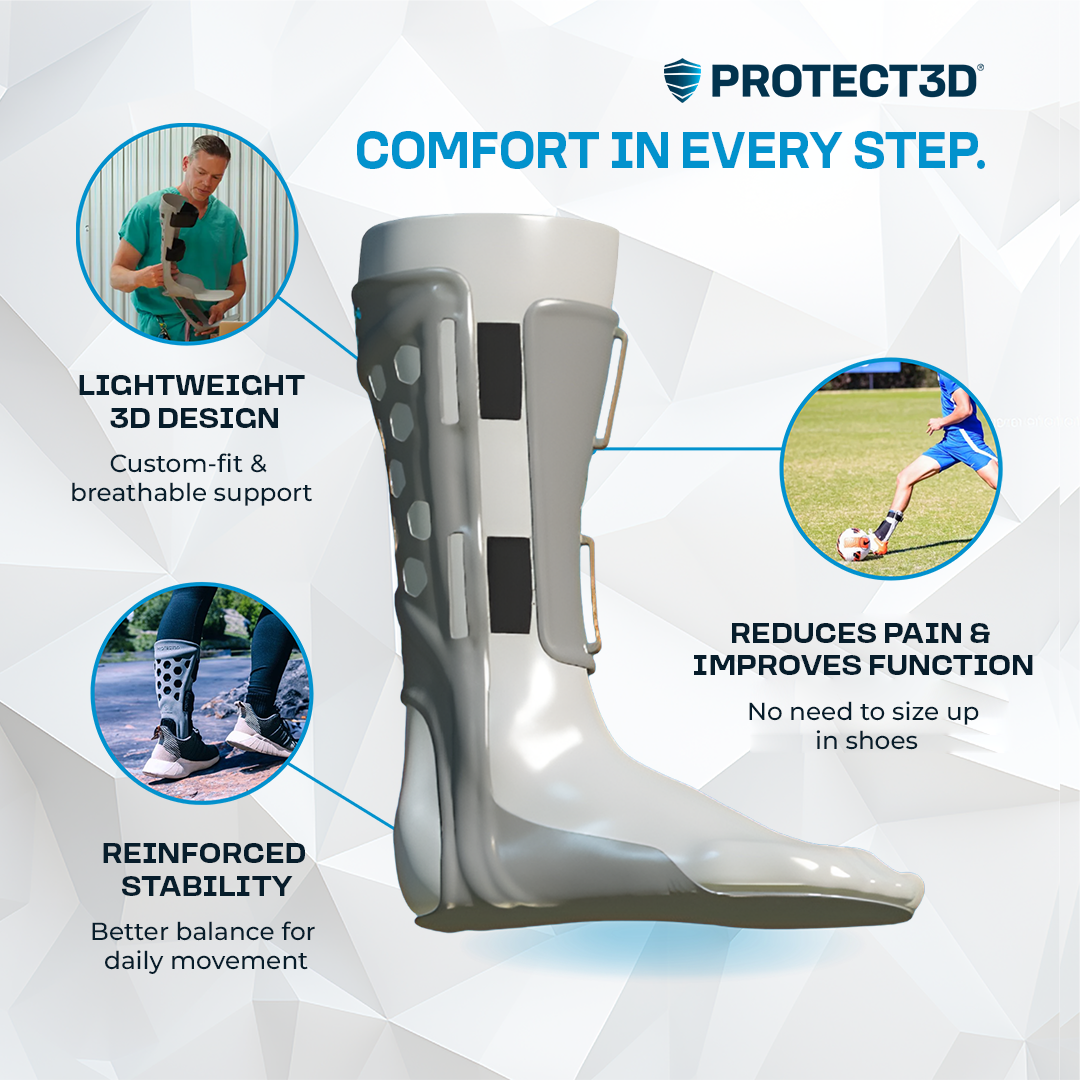
The PROTECT3D AFO is a next-generation, pathology-specific brace designed to support natural gait through dynamic energy return rather than immobilization. Using a quick iPhone-based 3D scan, clinicians can prescribe a lightweight, low-profile brace that fits inside a regular shoe and is custom-made for each patient’s anatomy and diagnosis.
This approach has proven especially valuable across three common clinical indications: ankle arthritis, posterior tibial tendon dysfunction (PTTD), and foot drop.
AFO Product Overview: Designed for Motion, Not Immobilization
The PROTECT3D AFO is a custom 3D-printed orthosis created to bend, store energy, and return that energy during gait. Instead of locking the ankle, this patent-pending product supports controlled motion and propulsion.
Key features include:
- Lightweight, low-profile design that fits into standard footwear
- Advanced 3D-printed polymer for durability and energy return
- Custom fit generated from a quick iPhone 3D scan
- Alternative to traditional AFOs and Arizona-style braces
- Covered by insurance and PDAC-approved
Designed for foot drop, ankle arthritis, hindfoot arthritis, and PTTD
For clinicians, the platform also creates opportunities for wholesale purchasing and insurance reimbursement, allowing bracing to become both a clinical and operational asset.
Ankle Arthritis: Reducing Pain While Preserving Mobility
According to the Hospital for Special Surgery, ankle arthritis occurs when cartilage within the ankle joint degenerates, leading to pain, stiffness, and reduced range of motion. While most commonly associated with osteoarthritis, ankle arthritis can also result from inflammatory conditions or previous trauma, such as fractures.
Patients often report worsening pain with activity and increasing discomfort later in the day. Traditional bracing strategies frequently focus on restricting motion, which can reduce pain but also limit function and endurance leading to a diminished quality of life.
The PROTECT3D AFO takes a different approach.
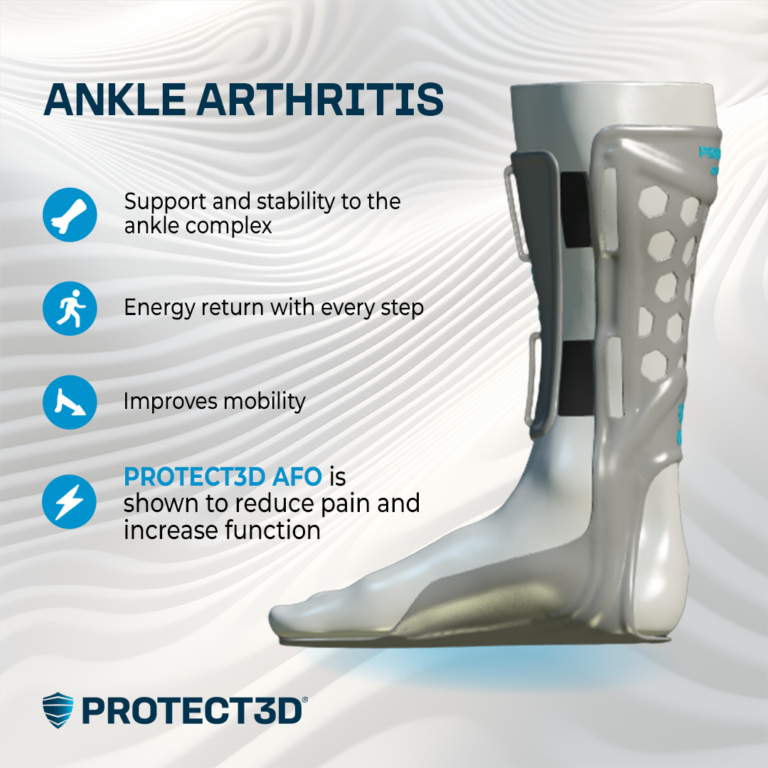
Rather than locking down the joint, the PROTECT3D AFO is designed to stabilize the ankle complex, then bend and spring back with every step, effectively unloading the ankle joint. The energy-returning design helps propel the patient forward, reducing fatigue and allowing longer periods of walking with less pain. For many patients, this can delay or reduce the need for surgical intervention.
Posterior Tibial Tendon Dysfunction (PTTD): Supporting the Arch & Delivering an Energy Efficient Gait Cycle
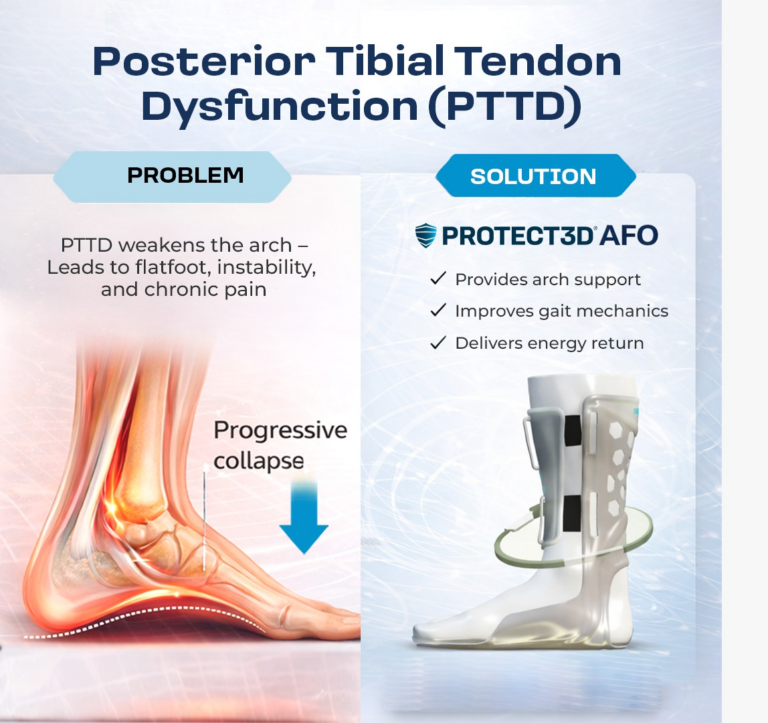
Posterior tibial tendon dysfunction is a progressive condition and the leading cause of adult-acquired flatfoot, as outlined by the American College of Foot and Ankle Surgeons. As the posterior tibial tendon weakens, it loses its ability to support the medial arch, resulting in the foot flattening and increased pain.
Early and mid-stage intervention is critical. Once the foot collapses fully, pain increases, and conservative treatment options become limited.
The PROTECT3D AFO is particularly effective for PTTD because it is designed using a semi-weight-bearing 3D scan. This allows the brace to capture and support the patient’s arch while it’s not in a collapsed position. By stabilizing the ankle joint, providing that arch support, and offering dynamic energy return, the PROTECT3D AFO helps patients walk more efficiently. It has had dramatic impacts on patients dealing with the day-to-day pain and discomfort of PTTD.
Foot Drop: Lighter Support With Greater Comfort
Foot drop, as described by the Mayo Clinic, refers to difficulty lifting the front part of the foot during walking. It is not a disease itself, but a symptom of underlying neurological, muscular, or anatomical issues. Without support, patients may drag their feet, increasing the risk of tripping and falls.
Many traditional AFOs address foot drop by holding the foot in a fixed position. While effective, these devices are often bulky, heavy, and uncomfortable, leading to poor compliance.
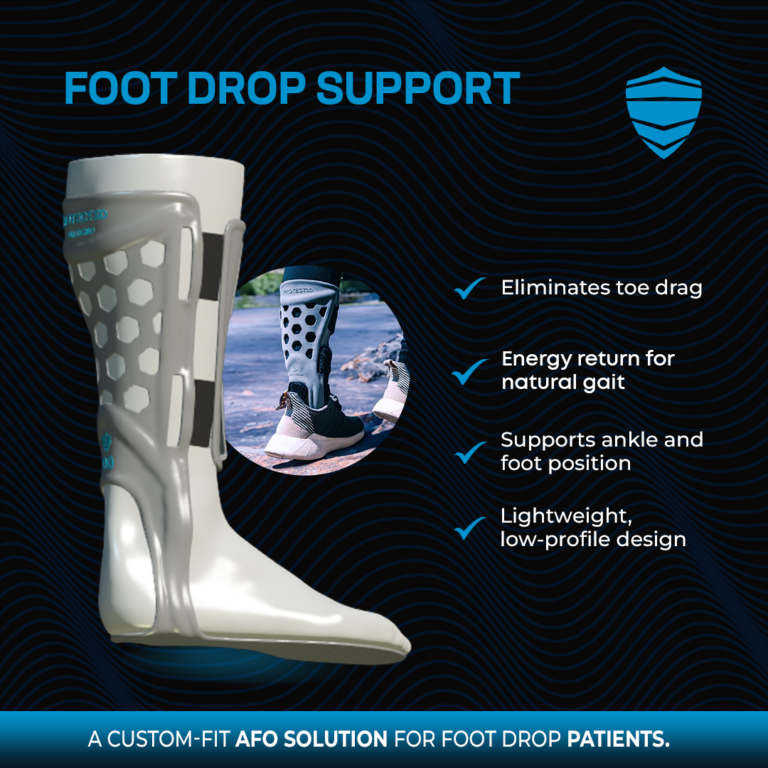
The PROTECT3D AFO provides the necessary dorsiflexion support while remaining lighter and lower profile than conventional options. The custom fit improves comfort and allows for a seamless fit in the patient’s regular shoes., and The energy-returning material assists with forward motion, helping patients maintain a more natural gait pattern.
Why Clinicians Are Reconsidering the Role of the AFO
Across ankle arthritis, PTTD, and foot drop, the common clinical challenge is balancing stability with mobility. Immobilization can reduce pain, but it often limits function and long-term adherence.
A patient- and pathology-specific AFO that supports motion, stores energy, and returns it during gait offers a more modern solution. For clinicians, this means:
- Improved patient comfort and compliance
- Support tailored to the underlying pathology
- A streamlined digital ordering process
- A scalable model for in-clinic bracing
As 3D printing and digital workflows continue to evolve, AFOs are no longer just supportive devices. They are becoming integral tools in delivering better outcomes for complex foot and ankle conditions.
Learn More About the PROTECT3D AFO
The PROTECT3D Platform allows clinicians to prescribe custom AFOs using a simple iPhone scan, with designs tailored to specific diagnoses and patient anatomy.
To explore how the PROTECT3D AFO can support patients with ankle arthritis, PTTD, or foot drop, visit our AFO product page or connect with our clinical team to learn more about integrating this solution into your practice.
References
- Hospital for Special Surgery. Arthritis of the Foot and Ankle. https://www.hss.edu/health-library/conditions-and-treatments/list/arthritis-foot-ankle#:~:text=Ankle%20arthritis%20is%20when%20cartilage,and%20become%20rough%20and%20worn.
- American College of Foot and Ankle Surgeons (ACFAS). Posterior Tibial Tendon Dysfunction (PTTD). https://www.foothealthfacts.org/conditions/posterior-tibial-tendon-dysfunction-(pttd). Accessed 21 October 2025.
- Mayo Clinic. Foot drop – Symptoms and causes. https://www.mayoclinic.org/diseases-conditions/foot-drop/symptoms-causes/syc-20372628. Accessed 21 October 2025.