
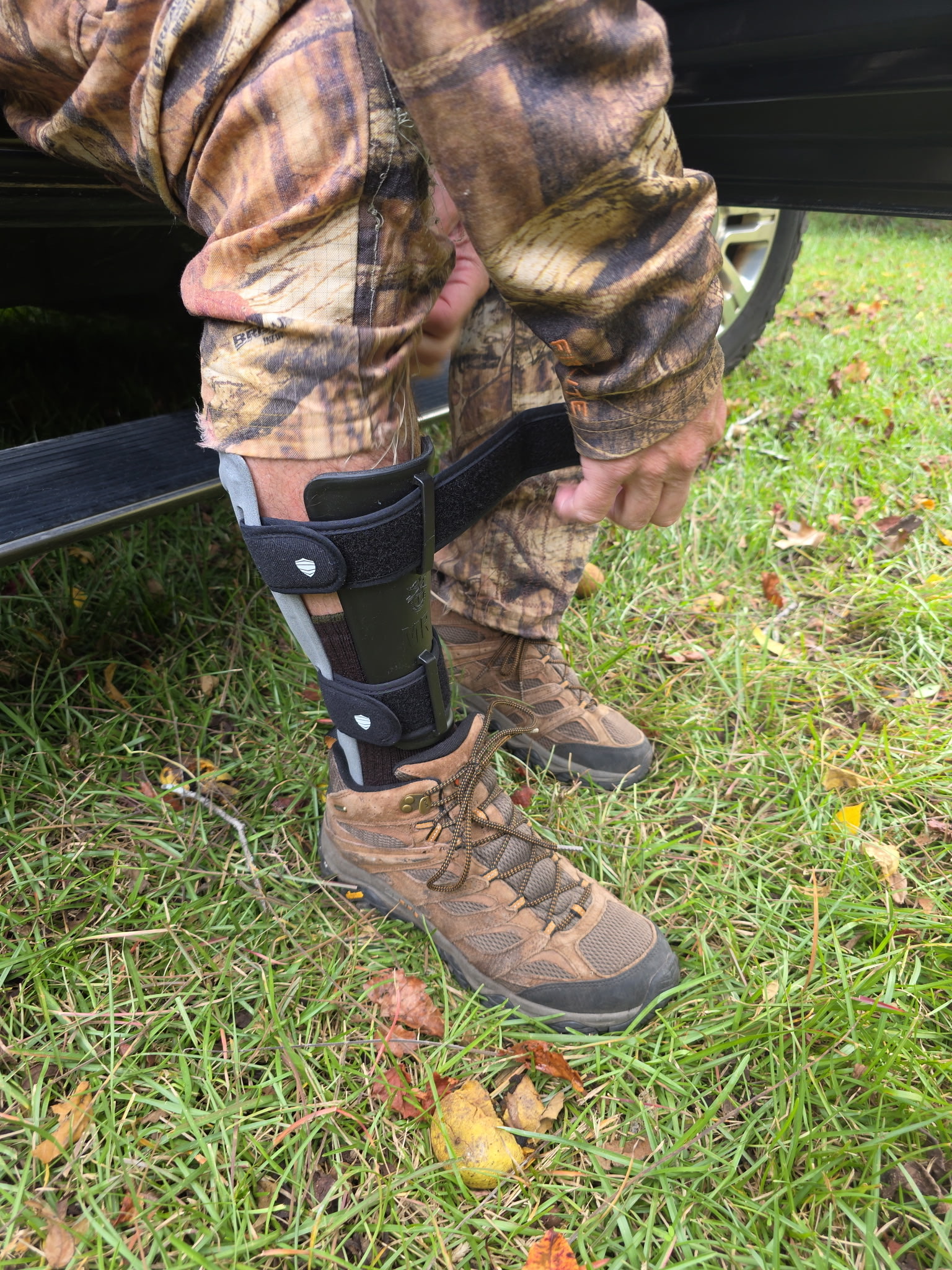
For more than a decade, retired U.S. Army Special Forces operator Mike Ray has lived with foot drop, a condition that makes lifting the front of the foot difficult and often leads to tripping, imbalance, and chronic pain. The injury traces back to a combat operation in Afghanistan in the mid-2000s, when Mike was ejected from an all-terrain vehicle during a firefight. Among multiple injuries, he sustained compressed L3–L5 vertebrae, resulting in a peroneal nerve injury that ultimately caused foot drop.
Like many veterans, Mike had tried multiple Ankle Foot Orthoses (AFOs) over the years, each promising relief but falling short. Most were too bulky for his boots, uncomfortable after a few hours, and impossible to fit under normal pants. The pain in his Achilles would grow worse the longer he wore them.
Eventually, he stopped wearing them altogether. As he put it, “I’d rather trip from my drop foot than go through expensive shoes and daily discomfort.”
The Moment Everything Changed
That all shifted when Mike tried the PROTECT3D AFO for the first time.
He recalled, “Imagine a former Green Beret having trouble walking through the woods, until last Saturday, while wearing your AFO.”
He was out hunting with his grandson, carrying all their gear through the woods, a familiar challenge that used to end in tripping or falling, especially in low light. But this time was different.
“It was the first time I can remember in a dozen years that I didn’t trip or fall. What would be unremarkable for others was, for me, like being relieved of pain for the first time. Other than initially putting it on, I forgot it was there.”
That single outing marked a turning point. What had once felt impossible, walking steadily and safely through uneven terrain, was suddenly natural again. It wasn’t just a functional improvement; it was a return to confidence, independence, and identity.
Why Fit and Comfort Matter
Mike’s experience is a powerful reminder of how critical comfort and precision are in orthotic design. For patients with foot drop, ankle arthritis, PTTD, or post-op recovery needs, the right brace must provide both support and freedom of motion.
Traditional AFOs often rely on manual casting methods that can result in inconsistent fit, excessive bulk, and limited wearability. PROTECT3D’s approach is different.
Using mobile 3D scanning and digital manufacturing, clinicians can capture each patient’s anatomy down to the millimeter. The result is a lightweight, low-profile brace that fits naturally within everyday shoes, restores mobility, and reduces fatigue, allowing users to move confidently and comfortably all day long.
Restoring More Than Mobility
When Mike described his experience, he wasn’t talking about technology; he was talking about life.
“I tried for years to replace the AFO I had, to no avail. Until now. I hope you have the opportunity to help other soldiers with a few extra miles on their chassis.”
That’s the real measure of success: not just an improved gait, but an enhanced life.
At PROTECT3D, we are proud to support the veteran community with bracing solutions that truly work, designed for everyday function, built for comfort, and created with the precision of 3D technology. We recognize that the transition from military service to civilian life brings unique physical and functional challenges, and our work is guided by a deep respect for those experiences. In close alignment with the US Department of Veterans Affairs (VA), we remain focused on one goal: delivering clinically sound solutions that genuinely improve veterans’ daily lives.
Supporting Veterans, Empowering Providers
Mike’s story illustrates what’s possible when innovation meets compassion. The same digital tools that helped him regain his footing are being used by clinicians, orthopedic specialists, and VA centers nationwide to improve outcomes for patients across conditions such as:
- Foot Drop: restores safe, efficient gait mechanics
- Ankle and Hindfoot Arthritis: supports motion while reducing pain
- Posterior Tibial Tendon Dysfunction (PTTD): stabilizes the arch and provides energy return
- Post-Surgical and Athletic Recovery: provides light, durable protection
For clinicians, the process is simple:
- Scan: Capture the patient’s limb using a mobile 3D scan in minutes
- Design: Collaborate with PROTECT3D engineers to tailor the brace to the patient’s needs
- Deliver: Receive the final device within days, ready for fitting and use
This digital workflow eliminates casting, accelerates turnaround, and improves accuracy, helping providers serve more patients with less delay.
Freedom in Every Step
Every patient deserves to feel confident in motion. For Mike Ray, that confidence came back the moment he took his first steady steps in the PROTECT3D AFO.
His story stands as a testament to what’s possible when precision technology meets purpose-driven care, and as a call to action for clinicians and VA centers ready to offer the same transformative results.
At PROTECT3D, we’re proud to protect the freedom of movement for those who’ve already given so much.
To learn more about bringing the PROTECT3D AFO to your clinic, VA center, or to a loved one in need, visit our website and connect with our team.